Knowledge Repository
Explore our collection of knowledge resources and documents.
Find valuable information below.

Revenue Information Management System
Revenue Information Management System is an initiative of the Gauteng Provincial Department of Roads and Transport. It sought to eradicate challenges that confronted the department when it came to revenue collection. In an attempt by Gauteng Department of Roads and Transport to improve service delivery and accessibility to motor vehicle renewal services, a total number of 259 Post Offices in Gauteng were appointed as agents for the Department. In addition, 6 Provincial centres were established. The two institutions were to surrender collected revenues on daily basis to the department. The Department struggled over the years to timeously collect all revenues that had been collected at various municipal centres even though municipalities were only required to surrender the net revenue 21 days after the month of collection. For example, in 2009/2010 financial period, the Department was receiving only 33.87% receipts within due date and 58.79% received after the due date and the balance of 7.31% being continuously outstanding. This was the main area of concern. In addition, many audit queries were received from the Auditor General. The RIMS solution sought to address these challenges.
Date: 2026/11/18
Version: 0.1
Tags:
Public Finance Management Solutions
Financial Management Improvement Project
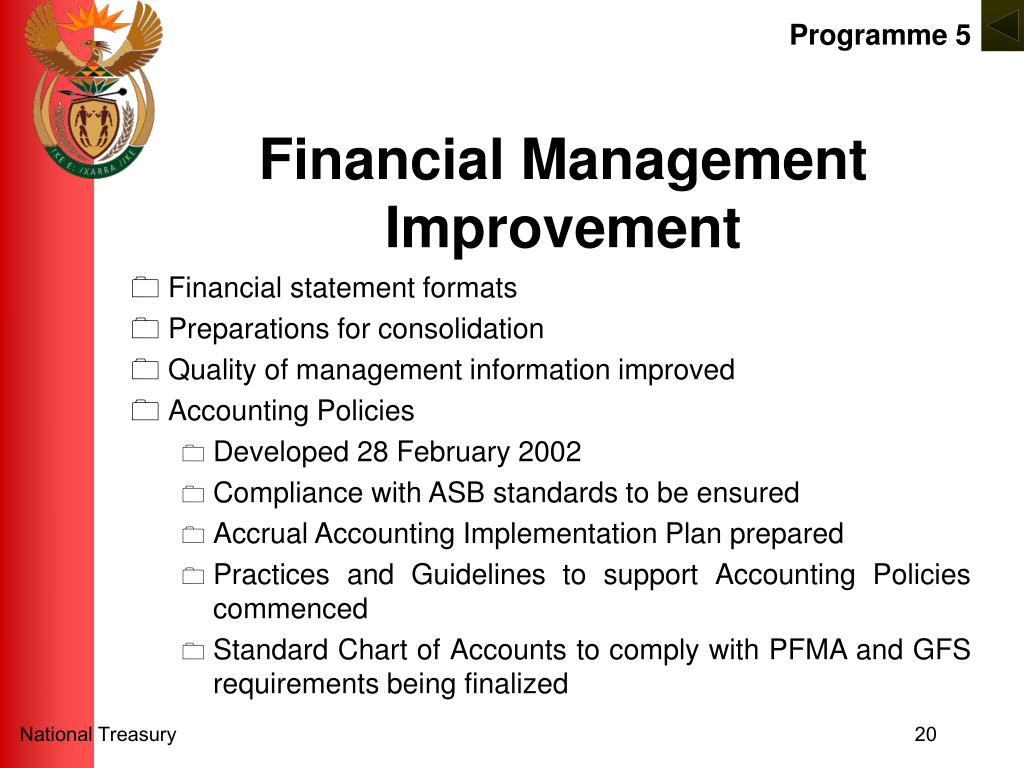
The National Treasury has a responsibility to help the three spheres of government build their capacity for sound and transparent financial management. Accordingly, the Capacity Building Unit which resides in the Accountant General’s office had drafted a capacity development strategy for public financial management. To implement the capacity development strategy, multiple financial management development projects needed to be initiated and managed by the Capacity Building Unit for implementation across the three spheres of government. Most of these projects were donor funded and managed by different directorates in conjunction with the relevant donors. Due to the complexity of projects and ensuring that projects were delivered in line with cost and timeline constraints, the management of information inputs and outputs required rigid propositions, coordinating, monitoring, evaluation and reporting systems. This included methodologies to be put in place to ensure that the projects were in line with needs analysed, properly approved by the relevant stakeholders and that funds are correctly allocated and utilised. Hence, the design, development and automation of an online project management tool to rigidly manage macro projects.
Date: 2026/11/18
Version: 0.1
Tags:
Public Finance Management Solutions

Budget Management Instrument and Approved Post List
Health departments are very large and complex organisations. The Western Cape Department of Health (WCDoH) is no exception. Due to the high level of decentralisation, budgets are managed at various levels within the organisation. The challenge facing the Western Cape Department of Health was the provision of tools to assist facilities and regional managers to understand, project and manage their expenses. Since personnel expenses account for 60% of all expenses, we wanted to assist managers to calculate and identify the funded post. The department came up with tools that would make the work of facility managers easier to perform. The tools consist of large Excel database that combine information from the procurement, personnel administration and general ledger system (mainly LOGIS, BAS, PERSAL) and that contain analysis of expenses, month by month, analysis of staff cost, per employee, detailed projections of expenses which management may adjust, as well as a comparison of the funded posts with the posts that are active on the personnel administration system. In order to solve this problem, the provincial department of health came up with the Budget Management Instrument (BMI), the Approved Post List (APL) and the Finance Monitoring Committee (FMC).
Date: 2026/11/18
Version: 0.1
Tags:
Public Finance Management Solutions